
Happily Ever After follows Kitty Lin (Shuhua Yeh), a woman who seems to have it all. She is a competent employee at a retail store, has a loving boyfriend, is adored by her parents and is close to her only sister, Claire Lin (Xuan Chen). On top of that, she is well-mannered, well-liked, beautiful, and an all-around “perfect” daughter and woman. All seems to be going well for Kitty until she gets proposed to by her boyfriend, Ledo Yang (Kent Tsai), who comes from a well-off family with loads of expectations and standards that the already lovely Kitty can’t seem to meet or is intimidated by. Oh, and she adopts a street cat who seems to be unwittingly a catalyst for an emotional unravelling between her and her sister.
Meanwhile, Claire, the older sister, is doing well as a writer, secretly harbouring a girlfriend away from her conservative parents, and, on the surface, is a “failure” to her parents. She is the one at odds with her ‘parents’ expectations, when, realistically, she is worthy of praise for following her own path. Claire sees Kitty not as the perfect daughter but as someone who is actually sad. She sees her sister as someone who is compromising on her promise for the sake of stability and “normality.” Happiness is ultimately defined very differently for the sisters, and judgment, expectations and reality collide in this sensitive portrait of womanhood and sisterhood.
What I enjoyed about this film is the realism. The lack of massive overreaching drama and explosive confrontations is built on believable remarks and situations that stack up. The subtleties that knock down Kitty’s confidence or frustrate Claire are, honestly, commonplace in most households defined by culture, traditions, and gendered expectations. Here, a stray cat taken in by Kitty on a whim is the catalyst for the issues they keep buried that slowly surface. The cat, despite being very cute, is the wrecking ball that demolishes the facade Kitty and Claire maintain to appease their parents, each other and themselves. In a way, Feng-I Fiona Roan reminds us that the littlest, most innocuous things can be the ones that set us off.
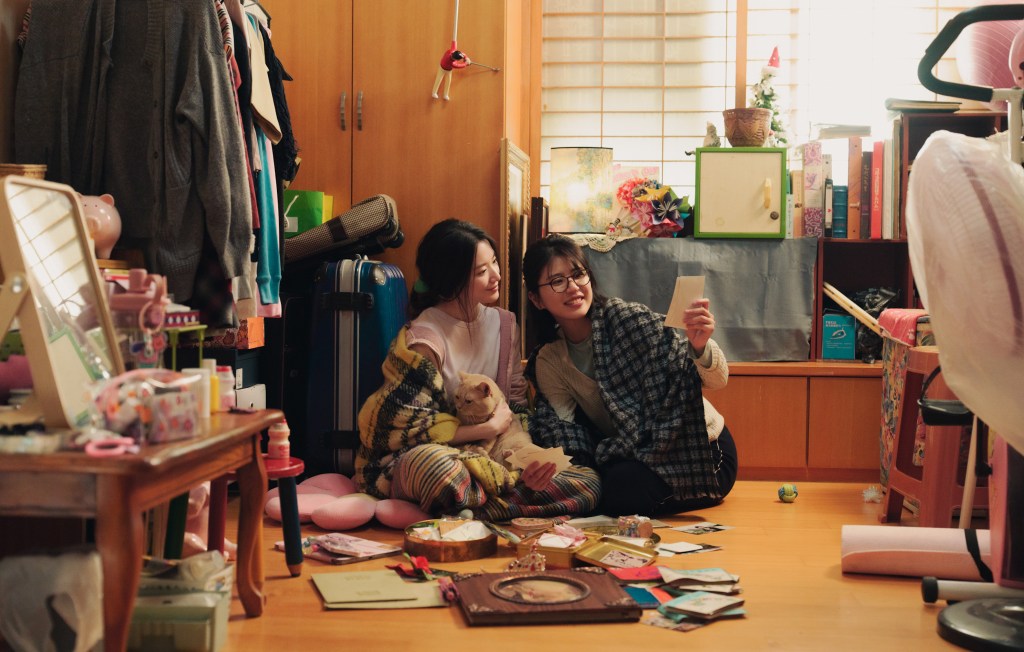
The film’s main theme is happiness, and what it means to achieve it and what exactly it is to each of us. For Kitty, happiness is somewhat artificial– a good home life, a good relationship with her parents, approval from her in-laws, marriage, a stable career, and then kids. Claire perceives these ambitions to be shallow, reminiscent of the dynamic between Meg and Jo in Louisa May Alcott’s Little Women. Through her perception of Kitty, Claire moulds her happiness differently. Her independence, both financially and emotionally from her parents, affords her the clarity she needs to see what makes her happy and how to get it. Kitty represents so many women who exist to meet expectations and are never given the time or space to reminisce or reflect on the choices that lead them where they inevitably end up.
Shuhua makes her acting debut here, and it is a stark contrast to her glamorous life as a K-pop idol in the mega-popular i-dle. Here, she is much more subdued, playing a woman who timidly moves through life, never making herself too loud about what she wants. Kitty is filled with contradictions, though, and Shuhua elegantly portrays a young woman who chases after approval and love, while having short bursts of selfishness and bratty tendencies due to her being clearly the favourite child. There is little about Kitty that feels malicious. However, at a turning point in Kitty and Claire’s relationship, Shuhua expertly switches it up to highlight Kitty’s sharp tongue and pettiness. By contrast, Claire, played by Xuan Chen, exudes a cool, confident exterior, deliberately isolating herself from her parents to avoid sparking an argument or drawing too much attention to her life and relationship. Claire is very reminiscent of many elder daughters who don’t quite live up to their parents’ dreams or expectations, but still maintains a rather strong spine and sense of self that is only strengthened by their parents’ unwillingness to compromise. Let’s say Claire struck closer to home than the spoiled younger sister.
The film rises above most familial dramas about similar family dynamics by emphasizing that these characters are human; none are perfect. Their ambitions, while simple and achievable, can still induce drama. The parents may fit an archetype, and at times lean into stereotypes, but are incredibly familiar. The film’s smallest flaw is that some moments and scenes could have been leaned into a bit harder to better understand the character and their perspective. However, Roan captures the very human interactions and situations we all encounter, with many moments when much is left unsaid, and time is the main factor in either helping or exacerbating the issues at hand. Sometimes life doesn’t have the easiest of resolutions, and sometimes happiness is more or less bittersweet.
Happily Ever After is a sensitive, carefully crafted debut feature that shows the promise of Feng-I Fiona Roan as a burgeoning filmmaker and Shuhua and Chen as rising actresses. It is obvious that Shuhua’s popularity as a K-pop star will bring tons of attention to this film, and that popularity will not lead you astray. Happily Ever After is a well-orchestrated slice-of-life drama that manages to elicit strong responses and excitement for Shuhua, Xuan Chen, and Feng-I Fiona Roan’s future ventures in film.



Leave a comment