
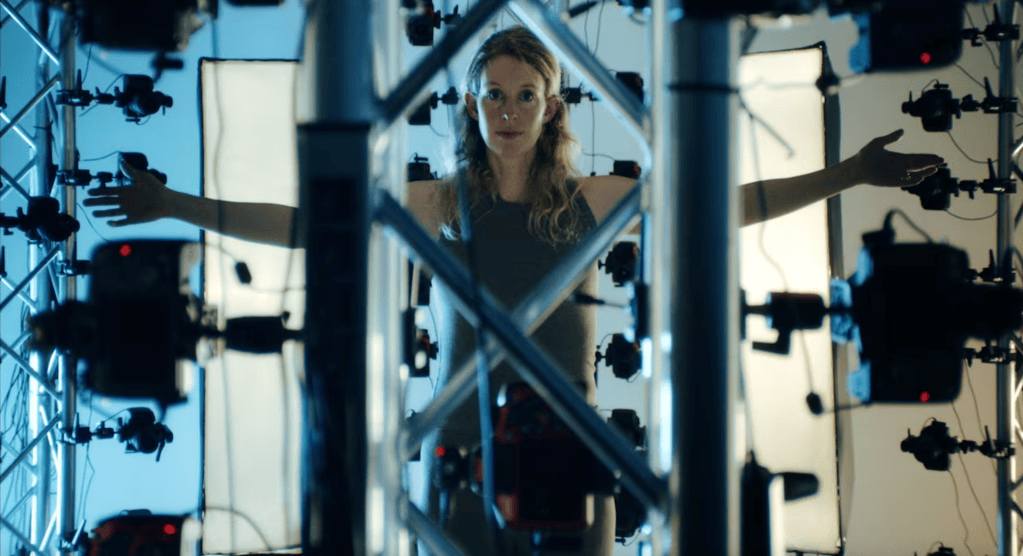
I got my start in entertainment and in journalism with documentary film. I was recruited to join my college paper while in a documentary film class, started making short documentaries and eventually transitioned to writing for the entertainment section.
As inspiring, impactful, and important as documentary film can be, it’s often not seen as a priority or as commercially viable, and is often relegated to arthouse theatres, film festivals, cable television, or self-publishing on YouTube. Maybe a doc will get picked up by a streaming service if you’re lucky.
Even considering how big of a news story the Elizabeth Holmes and Theranos fraud was and the countless dramatizations that followed, including Hulu’s The Dropout starring Amanda Seyfried, I find it unlikely that a normal documentary about Holmes would make much of a splash or get a major theatrical run, especially three years after she already went to prison. I say “normal” because A24’s new film You Can See Everything is anything but.
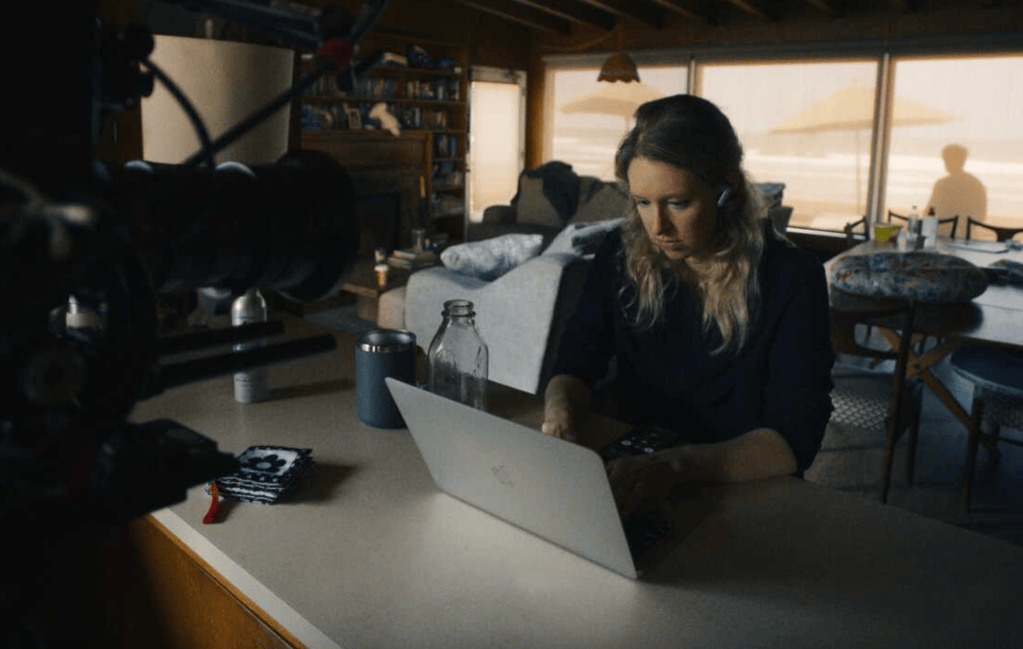
For starters, it’s co-directed and co-produced by comedian/absurdist/professional awkward person Nathan Fielder. If you know anything about Fielder’s work and style, then his fingerprints are all over the place. The movie is weird. It’s funny. It has a sharp and intelligent perspective delivered with a dry, blunt wit. You can tell that every angle, every shot and every second of footage has been meticulously measured and calculated. Holmes may be a fascinating subject, but Fielder is undoubtedly the draw here.
But, maybe, I’m getting ahead of myself here.
You Can See Everything is a film co-directed by Fielder and Lance Oppenheim that chronicles the final month before Holmes went to prison for committing fraud on her investors. Holmes and her fiancé, Billy Evans, invited Fielder to live with them, witness their lives, and create a documentary to humanize Holmes and possibly convince the audience of her innocence.
And it kind of works. The Holmes we see is such a strange specimen. She’s clearly very intelligent but also socially inept, and the film seems to suggest she may be neurodivergent. However, I’m not a licensed psychiatrist, so I can’t say for certain. She’s unrepentant for her crimes because why would she be? After all, she maintains her innocence throughout it. And not only that, but she’s trying to do it all over again, spending her last days of freedom hard at work trying to start another company and pick up the pieces of what she built with Theranos. I have no doubt Holmes committed the crimes she was convicted of, but I truly started to question whether she understood that her actions are, by and large, considered wrong.

Meanwhile, Holmes’ latest romantic (and business) partner, Billy Evans, skulks around corners and hovers over her shoulder, swooping in to cut her off and save her just when Fielder is getting to the juicy bits or actually uncovering substantive material. Is he doing this to shield his wife and prevent her from saying something that will make her look bad, or is it because he’s shielding himself? It was his idea that Fielder should come and make a documentary about his wife, but Evans constantly gives the impression that he does not want them there.
And then Holmes goes to prison. And somehow the film only gets more insane from there.
The film that’s supposed to be about Elizabeth Holmes doesn’t really feature her again after this. The focus instead shifts to Billy, who now acts in his wife’s stead, making decisions about their company without consulting her. Power corrupts, and absolute power corrupts absolutely. It’s clear from his early interactions with Fielder that Evans is not a normal man, and that growing up wealthy has framed his view of life and the world very differently. However, with Elizabeth out of the picture, the dark and disturbing tendencies that Evans only hinted at are on full and unashamed display. That he knows he is on camera and still chooses to portray himself in this light is absolutely chilling.
Of course, Holmes is in prison, so it’s not like she can sit for hours of on-camera interviews. Fielder does what he can to still include her in some form, which, true to his style, means using actors to recreate and reenact conversations with Holmes that he was not allowed to record or was otherwise unable to record. Without giving too much away, this is where the Fielder weirdness really shines through, and everything gets farcically meta and loops inward on itself, with the levels of realism, drama, comedy, and the repeating patterns of Holmes’ life that the filmmakers try to blend. And this is where I wonder if the film Fielder is making can truly be called a documentary.

Documentaries feature reenactments all the time. Turn on The History Channel or pick a true-crime documentary at random, and you’re bound to find plenty of reenacted scenarios. You Can See Everything sometimes feels like a big-budget version of something I’d catch my mom watching at 11 PM on Investigation Discovery. But with those recreations comes the perspective. We’re seeing these events not as they really happened, but as Fielder remembers them. Or at least how he claims to remember them.
Aside from how rivetingly bizarre Fielder and Oppenheim’s subjects are, what makes this whole project so unique and what blurs the line between documentary and dramatization/fictionalization is Fielder’s presence. Other documentarians either take the cinema verite route and try to be as unobtrusive as a fly on the wall or as a disembodied voice asking questions. Fielder is an active player in this. He’s a character in the story he’s telling, whether or not that character is the comedian Nathan Fielder that we have all come to know or a different, more serious Fielder, I’m not sure.
I’m not even talking about bias here. All filmmakers, documentarians, and artists have a perspective and a bias, no matter how objective they strive to be. There is a point at which Fielder is no longer simply presenting the information and his subjects as they are, as the camera captures them, and he transitions to crafting the story himself. The whole reason Holmes says she wanted to make this documentary is that she was tired of people telling her story without her input, and she wanted a chance to show who she really is. It’s ironic that at a certain point in the film (no spoilers, but you’ll know what I’m talking about when you get to that part) Fielder ends up doing just that. That may be the point.
All of this leaves me with questions. What does Fielder think about Elizabeth Holmes’ guilt and culpability? How seriously is he taking this project? How have his views shifted over time? Is he somehow trying to protect Holmes? What else happened during their time together that he and Oppenheim are choosing not to show us? Some of these questions are easier to answer than others. Some of them we will never get the straight answers to. They’re still rattling around in my head over 24 hours after I saw the film.

My only frustration is that Fielder tugs at certain strings or uncovers information only to leave those lines of questioning maddeningly unanswered and unresolved. There are bombshell moments and lines of intrigue that suddenly reframe or twist the entire narrative. It’s up to the filmmakers to determine whether they gathered more information about those aspects of Holmes and Evans’ lives, and, if so, why they chose not to include them in the discussion. We’re being asked to go along for this ride with Fielder and Holmes, teased with the carrot of knowledge, but when we reach out for a bite, it’s only natural to get upset when the carrot gets pulled away.
There is a master manipulator somewhere in all of this. It could be Evans, who, with his wife out of the way, can shape the company as he sees fit and wield Holmes’ notoriety as a tool. It could be Fielder and Oppenheim, the filmmakers who have seen everything, who decide what the audience gets to see and who shape this next chapter of the Elizabeth Holmes narrative. Or is it really Elizabeth Holmes playing puppet master from the shadows, beguiling and deceiving everyone in her orbit to get what she wants while keeping her hands relatively clean?
This is probably the least conventional review I’ve ever written, but You Can See Everything is the most unconventional film I’ve ever seen. Holmes, Evans and even Fielder are enigmatic and engrossing figures to watch and absorb, and even with a two-hour-and-54-minute runtime, I was never bored and never felt the time pass. At the end of it all, my perception of Holmes is even more confused and muddled than before I watched the film. That’s not because Fielder and Oppenheim failed to do their jobs, but because they did it so well, and in the end, even they are inviting themselves up to scrutiny. Most documentary filmmakers or journalists strive to ensure objectivity and truth by not becoming part of the story themselves. No matter what project Fielder touches, the story will always be him just because that’s his whole brand and what audiences want from him. The brilliance of You Can See Everything is how well it leans into that.
Sure, we can see everything, but whether we know what to make of it all is a different question entirely.





Leave a Reply