
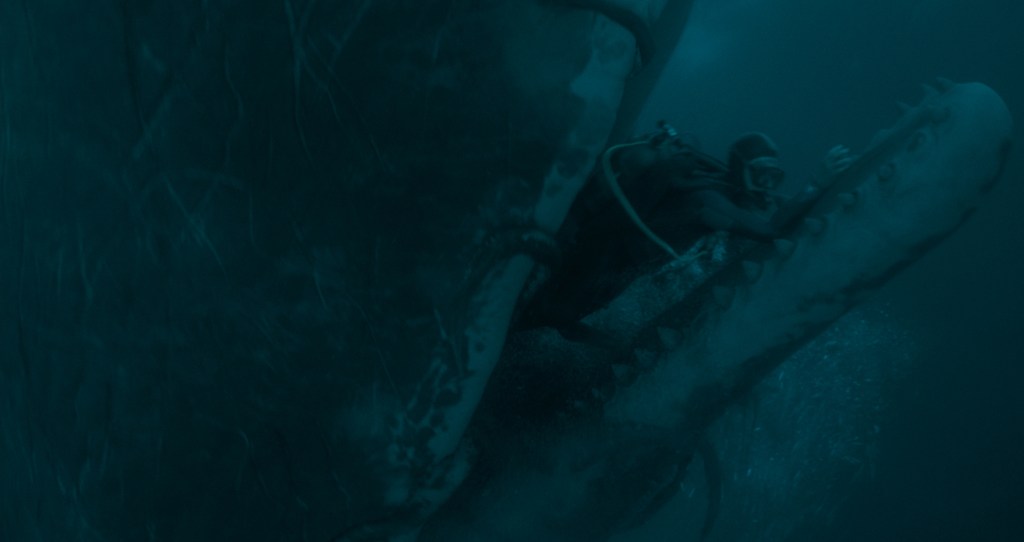
If you know anything about me, you know I enjoy a good creature feature. Whether it’s a creature of the night à la vampires and werewolves, or people running away from dinosaurs and trying to outswim sharks and other aquatic animals, I’ll watch it. That’s why I was interested in Whalefall in the first place: scuba diver accidentally swallowed by a sperm whale while it’s hunting for squid? Sign me up. Still, Whalefall isn’t your typical creature feature survival thriller.
Based on the novel of the same name by Daniel Kraus, Whalefall follows Jay Gardiner (Austin Abrams) as he returns to his oceanside hometown in California to visit his mother, Zara (Elisabeth Shue), and his two sisters, Eva (Jane Levy) and Nan (Emily Rudd). It’s been a year since their father Mitt’s (Josh Brolin) death, and Jay has a very different relationship to the memory of their father than his sisters. Throughout the movie, we see Jay wrestle with this and how, even after his father’s passing, he still doesn’t have the closure that many people hope for.
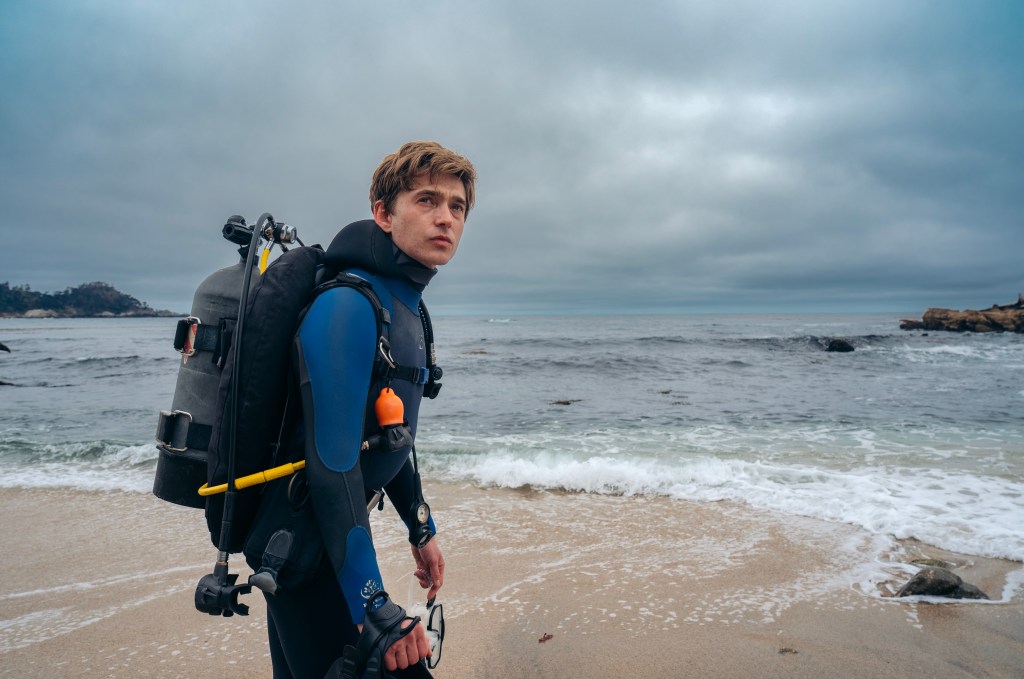
This begins Jay’s mission. He heads out for a dive – his first in years. Despite being warned by his father’s friend, Hewey (John Ortiz), that something is off in the water, he says the Coast Guard and other officers are on the beaches and in various diving zones, so Jay heads out anyway. Nervous at first, Jay settles in, and what begins as a routine dive becomes something far more dangerous when a giant squid emerges from the depths. The squid is scary enough, but when it is hunted by a sperm whale (the largest of the toothed whales), the fear factor increases exponentially. Grabbed by the squid, which the whale grabs, Jay is accidentally ingested, with only one hour before the oxygen in his tank is depleted.
Directed by Brian Duffield and written by Duffield and the book’s author, Kraus, Whalefall is definitely not the kind of movie you want to watch if you’re claustrophobic. Going from the open ocean to the whale’s stomach was jarring, and, at times, unnerving. You’re probably wondering how the fear of confined spaces can take hold when discussing the stomach of an animal as big as a whale. Well, when you’re trapped in there with an angry giant squid, there’s significantly less space to roam or rather swim/float around. Plus, once the whale’s peristalsis (the rhythmic contractions of the esophagus and forestomach that help churn food) kicks in, the extremely tight quarters become infinitely more dangerous.
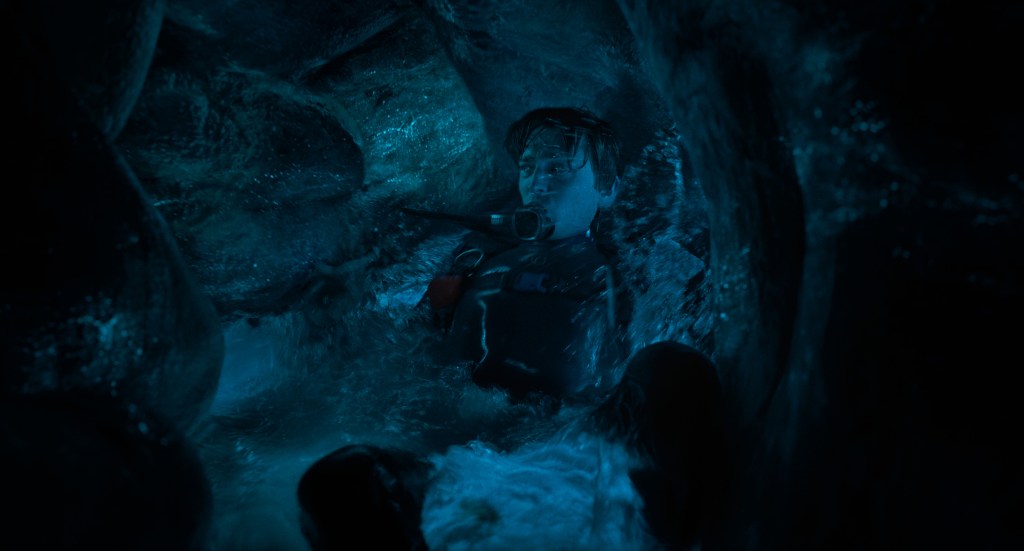
This, coupled with the countdown to lack of air, makes for a very uncomfortable experience. Of course, this is the point, so kudos to Duffield and Kraus for perfectly capturing the dire circumstances and Jay’s desperation to get himself out of the conundrum he faces. It’s equal parts distressing, disturbing, and a bit disgusting as the whale’s digestion journey begins to unfold. However, I was unable to look away. Whalefall expertly keeps you on the edge of your seat, and although some things might be a bit unbelievable, you sometimes have to suspend disbelief and ride the (stomach) waves.
Of course, all of this would be impossible without the capable acting of Austin Abrams in the lead role. As Jay, Abrams perfectly embodies everything that makes the character someone you want to root for. Despite his fear, Jay uses his knowledge and skills, even recalling what his father taught him, to improve his chances of survival and escape. Whether screaming in fear or getting emotional as he recounts a flashback of memory with his father, Abrams is pitch-perfect throughout the film’s runtime – something you need for a movie that deals with grief, unresolved conflict, and being swallowed by a whale.
As someone who hasn’t read Kraus’ book, I was unaware of the other themes it explores. Therefore, I went into the movie having only seen the first trailer, not knowing about the deeper subject matter in the plot. Kraus and Duffield’s screenplay does a great job of showcasing and exploring these themes seen through the various flashbacks that Jay experiences. What begins as a search for closure morphs into a survival thriller that isn’t solely about escaping the innards of a whale, but about grappling with grief and escaping those unresolved feelings or thoughts that settle after the loss of a loved one.
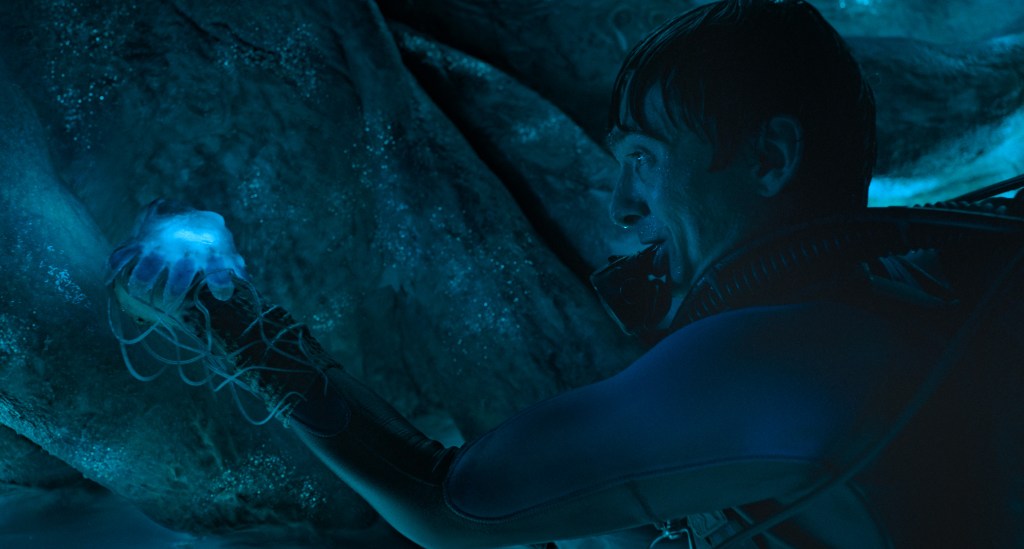
Not only is Whalefall narratively engaging, but it is also visually and aurally engaging. Let’s face it, the ocean is already scary enough, especially with so much of it unexplored. As I mentioned above, the inner workings of a whale’s anatomy were never really something I considered. And although I don’t know how anatomically correct everything is, the visual effects and sound design teams did fantastic work at creating a truly terrifying experience within the belly of the beast.
While you might be going to watch Whalefall for the zaniness of being trapped in a whale, you’ll likely leave the theatre thinking about mortality, grief, and the relief of finally feeling okay. Coupling cataclysmic claustrophobia with genuine scares and a deeper story, Whalefall is not your typical creature feature and is all the better for it.




Leave a Reply