

Hedda Gabler premiered in 1891; 134 years later, the play about the titular femme fatale still attracts storytellers. Henrik Ibsen’s play was initially poorly received, but in the nearly 200 years since its debut, it has been considered a masterpiece. The tale, which follows the antiheroine Hedda, a dramatic role coveted by the finest actresses of the stage across the world, has been told countless times on stage and brought to film with equal fervour, the last being in 2016.
Hedda, described as the female counterpart to Hamlet, is trapped in a marriage she doesn’t fully desire and in a home that she doesn’t enjoy. Bored with her life, she takes to playing with people’s lives in a game of dominance. In Nia DaCosta’s interpretation, we find Hedda Gabler (Tessa Thompson) in 1950s England, as a dissatisfied newlywed married to an ambitious but self-conscious scholar living in a large estate that neither can afford. She takes to spending her time playing with her guns left by her deceased father, General Gabler and plotting mischievous games to fulfill her. On one fateful night, Hedda and her husband George Tesman (Tom Bateman) throw a lavish bash at their home, inviting Hedda’s free-spirited friends and George’s colleagues, and an assortment of members of high society. The game is clear: Hedda wants George to secure a highly coveted academic position, and when Eileen Lovborg (Nina Hoss) struts into her home, the game begins.
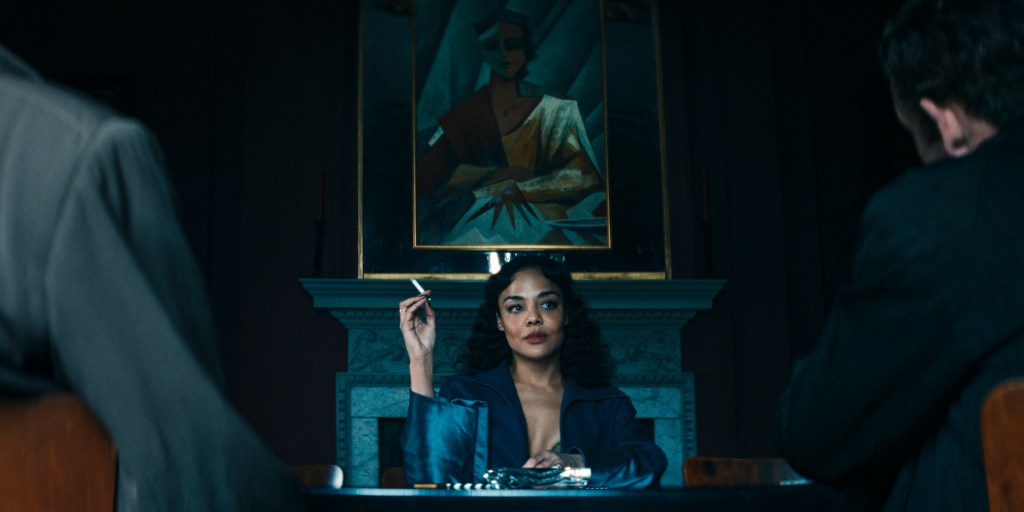
Hedda is a masterclass at tension building. Hedda, the character, is admirable for a myriad of qualities. She is intelligent, witty, seductive, personable and not in the least bit shy. She commands the room with her presence, despite her petite stature and glamorous looks, which are disarming and create the illusion of an unassuming person. Yet her decisions are…stressful. She winds up the people around her like a doll, cranking away until she gets the reaction she desires, although some responses are unexpected or have a bit of a delay. The film thrives on Hedda’s ability to insert herself into people’s minds and hearts, clawing her way into their consciousness until they are utterly obsessed with her. Granted, she doesn’t have absolute power over everyone she meets; she has her opponents—people who pay her no mind to her familial history—but that doesn’t stop her from persisting. As history has shown, persistence in a woman is a sight to behold. She holds so much power within this narrative because she is the source of all the trouble, drama, and action, as everyone else around her is forced to react.
In addition, Hedda is about the character. The situations around her could have gone exactly her way or taken a complete left, but the satisfaction of this narrative is knowing we are getting a rather whole arc of a spoiled femme fatale who is both victim and villain in her own story. The comparisons to Hamlet are apt; the self-destructive nature of the character is comparable, but what differentiates Hedda from so many antiheroes is that her gender and social standing shape her circumstances, and, despite her proximity to wealth, she remains constrained. DaCosta portrays Hedda as someone who is damned to let anyone, especially men, get the better of her, even if she is made more miserable by her actions. She is still someone everyone is desperate to keep up with; her husband wants her to control herself, her situationship partner wants her to humble herself, and her former lover unravels at her words. DaCosta goes further and dares us to acknowledge the human beneath the siren facade, repositioning Hedda as a woman of colour in a society that is already pretty hard on even white women, represented by Eileen and Thea (Imogen Poots). Hedda is dejected and a coward, but how DaCosta portrays it is with absolute sincerity.
Hedda is a production that requires two tour-de-force performances: one from the lead actress in the title role and the other from its writer-director. Hedda is no easy production to capture on film, let alone to transplant to a different time and cast with a woman of colour. DaCosta’s ambitions do, however, pay off as she zeroes in on one of the many things that make this story so riveting. Hedda is actually pretty damn cool. Now hear me out, yes, she is a rather awful, shallow, pitiful person! However, underneath her childish antics for attention and luxuries, a woman is fighting against society’s expectations, men who demand a version of her to satisfy their own egos, and limited mobility due to the circumstances of her birth. Hedda, like so many women, has the foresight to know that she doesn’t have total autonomy over her mind and body. While some quietly resign themselves to this fact, she takes a more radical approach to settling her restless spirit. To capture the essence of such a wily woman, you need an actress who can contain multitudes.
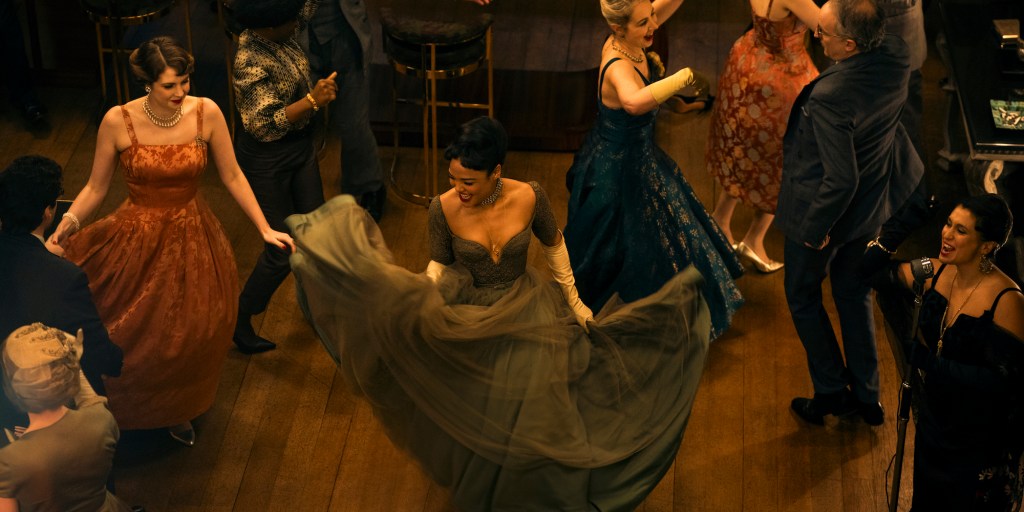
Tessa Thompson is a beast in this role. As she partakes in a classic aristocratic British accent, she shifts and slithers around the palatial home, sinking her teeth into her prey, laying traps and watching the world burn all around her. The subtle shifts in her eyes and twitch of her lips have more excitement and thrill than any of the Marvel films she has graced. Her manner of speaking is lyrical, nearly hypnotizing, and her movements are precise yet unpredictable. Hedda is a bundle of contradictions as she loathes commitment yet is deeply attached to her past lover, Eileen. She seeks validation and praise but holds herself back for some unknowable reason. At times, she has the maturity and calm to understand her circumstances, but at others, she allows her childish selfishness to lead her to reckless actions. At any given moment, you can see Thompson’s Hedda thinking, imagining the various scenarios unfolding around her, deciding which move will maximize chaos. For someone so distraught and unfulfilled, she is frighteningly good at staying on target and achieving her goals. Makes you wonder how far she can go if she applied herself elsewhere. At every turn, Thompson is utterly captivating as she captures the nuances of such a loathsome yet admirable woman.
As important as it is to have a firm anchor at the centre of this narrative, Hedda cannot be what it is without Thompson having chemistry with the supporting cast. Thompson’s performance opposite Tom Bateman as Hedda’s husband George Tesman and Nicholas Pinnock as Judge Roland Brack is wildly entertaining. First off, the men do a good job portraying the characters’ intense attraction to Hedda, with George seeking to tame her and Roland aiming to humble and own her. Imogen Poots’ Thea Clifton is a worthy adversary for Hedda as she represents all that Hedda is not. The two don’t engage much, but the push-and-pull of their motivations and personalities is a highlight of the picture. However, the most crucial relationship in the film is the one between Hedda and Eileen. Listen, who wouldn’t be obsessed with Nina Hoss, truly top-tier casting and ingenious considering Hoss played Hedda. Hoss is essential to bring to the foreground the implicit feminist themes of the play as the gender-bent professor whose self-destructive tendencies are taken advantage of by their former lover and muse. Thompson and Hoss are breathtaking together, with their chemistry palpable. There is no moment between them when we are treated to impactful expressions, line delivery, or action. The passion, anger, resentment and desperation between the two fills the air, leaving the audience both breathless and aghast. More can be said about the casting, but this is by far the most essential pairing.
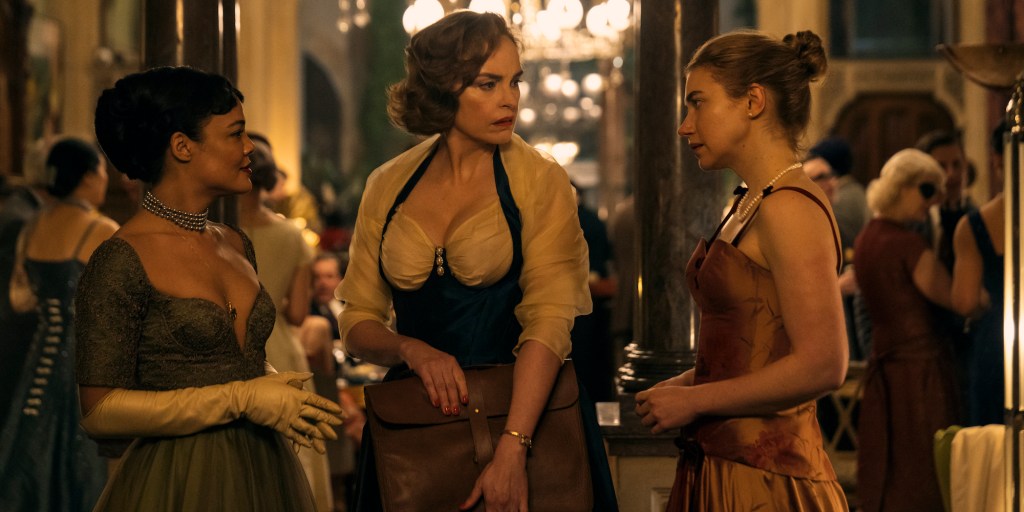
The film owes much of its success to Thompson as the lead; she is electric and keeps the momentum going from beginning to end. However, DaCosta really does the story — and, by extension, the audience — justice by opting out of a traditional adaptation and breathing new life into the nearly 200-year-old play by transplanting it to the vibrant post-war era. An era defined by a high-spirited lifestyle where art, music, academia and cocaine were the centre of people’s worlds. People have broken from the shackles of etiquette and tradition to an extent, and that is all reflected in the drama-laced evening at Hedda’s estate. From production design to set dressing to costuming, DaCosta leads a creative team that flourishes in creating a dynamic, vibrant space to serve as a backdrop for a central femme fatale’s elaborate chess game. The sound design, in particular, is exceptional at capturing the precise moments Hedda turns on and when she is vulnerable to her emotions.
DaCosta’s take is refreshing, blending elements of comedy, noir, and melodrama. Extrapolating the key points where Hedda becomes more than just a dangerous temptress, refusing to submit to expectations and turning this tragedy into a triumphant act of defiance. DaCosta has a sincere love and respect for the original play, but as a woman, she clearly sees its faults, specifically the ending. Hedda does so much to satisfy her hunger for excitement and gain control; why would she ever let a man win over her? She who is not above suggesting another to off themselves for her benefit? DaCosta sought the opportunity to rewrite Hedda’s narrative to balance the irrational, arrogant, manipulative qualities that made her famous with qualities that make her relatable and empathetic. These efforts, in turn, give us an exciting thrill ride, filled with tension, drama, horror, and sometimes a chuckle.
Hedda is a sensational adaptation, standing firm on the idea that modern adaptations of classic works are indeed made better when reinterpreted through contemporary worldviews. The central themes and plotting need to be damaged or disregarded; a modern interpretation can be both true to the source material and true to the current storyteller. Nia DaCosta deserves a round of applause.




 Muses of Media
Leave a comment