

*Please note: this review does not contain spoilers, but does have plot points from the film.
The tradition continues with the next instalment of the Knives Out Mystery series having its world premiere at the Toronto International Film Festival (TIFF). The final entry for Netflix, which bought the exclusive rights to two Knives Out sequels, is set to be released in December this year. Following Glass Onion, it will be sure to have a limited theatrical release before streaming on the platform. The whodunit series will likely continue with Lionsgate, but for now, Wake Up Dead Man can be seen as the final film of the unexpected, yet enjoyable trilogy. This time, we find Benoit Blanc (Daniel Craig) heading to the scenic destination of Upper New York state for a Church-themed mystery led by an eclectic group of familiar faces.
Our mystery centres around a young priest with a dark past, Jud Duplenticy (Josh O’Connor), who is removed from his previous posting to join a church in Upper New York state, working under an infamous priest, Msgr. Jefferson Wicks (Josh Brolin). Jud is eager to spread the word of Jesus and have a positive impact on the community, but his efforts are met with resistance by a stubborn flock loyal to Wicks. This flock includes Martha Declacroix (Glenn Close), Dr. Nat Sharp (Jeremy Renner), Vera Draven (Kerry Washington), Cy Draven (Daryl McCormack), Simone Vivane (Cailee Spaeny), Lee Ross (Andrew Ross), and Samson Holt (Thomas Haden Church). Each member has their reasons for following Wicks, from blind faith, to desperate hope, to loneliness, to a sense of obligation. As tension rises and resistance to Jud intensifies, a sudden death rocks the parish, and Jud is now at the epicentre of the drama. Luckily for him, the legendary Benoit Blanc has taken an interest in the impossible murder. Still, the crime may prove to be a greater challenge upon closer inspection by the duo and local police chief Geraldine Scott (Mila Kunis).

A chief complaint that will be lodged against Wake Up Dead Man is the lack of involvement the ensemble cast has with the central mystery. Even as the mystery was unravelling, the prospects of who was responsible were quite limited. Thomas Haden Church, Cailee Spaeny, Mila Kunis, Kerry Washington, Daryl McCormack, Jeremy Renner, Josh Brolin, and Glenn Close do not come close in screen time and relevance to Josh O’Connor. That is because he is positioned the same as Ana de Armas and Janelle Monae are in the prior Knives Out films, and next to Daniel Craig, the two eat up much of the screen time. However, Wake Up Dead Man does a lot less with the ensemble, and if the overall cast is the draw versus the mystery at hand, then it does fall short compared to Knives Out and Glass Onion. Johnson runs into his first massive obstacle, and that is the expectations from audiences and the studio to invest in an all-star cast. Johnson himself expressed that thematically and tonally this film would be different, and the first indication of that is the limited focus on a handful of characters. The film would have benefited more with lesser-known actors, because the interest in these actors far exceeds the interest in the mystery.
That being said, wow, what an incredible showcase of O’Connor’s talent and his chemistry with just about every actor on or off screen. He thoroughly steals the show with Duplenticy’s immense compassion, kindness, and consideration for others. He is an obvious inductee into the Hot Priest Club, which co-star Andrew Scott has been a member of for years now. Jud is a vessel to communicate the ideals of the church and faith. The church is the space for worship for the congregation, but it is also the place where people from different backgrounds, experiences, and levels of devotion can come together and create a community. That is what Jud stands for; additionally, his perspective, born from his own past, is profound and comforting. Add to it his position in this murder mystery, Jud represents the larger themes at play. Something Glass Onion lacked was a unifying theme that was the foundation of the mystery at hand. Wake Up Dead Man returns to the roots of the still-growing series to establish core ideals that cannot be denied in our current climate. However, O’Connor is also a competent comedic actor, and we got hints of what he could do with this role in Autumn de Wilde’s Emma. He is silly and comically relatable to the point where he makes up for the lack of involvement by everyone else.
On the flipside, we have Brolin and Close, who come close to obtaining the most relevance in the film. They both portray different parts of the religious/faith spectrum, with their ways of worship and belief contradicting that of Jud’s. That being said, they are great in their respective roles and bring to life starkly different yet compatible ways of believing. Washington and McCormack are underutilized, as is most of the cast, but their roles in particular feel very inconsequential, despite their actual characters’ connection to the Wicks and the church. Church, Scott and Spaeny have interesting roles, but their place in the story is mainly to flesh out the backdrop, with Renner and Kunis coming in at a few points to help the story along. For better or worse, the film primarily lives and dies on the cast that make up the church’s staff.
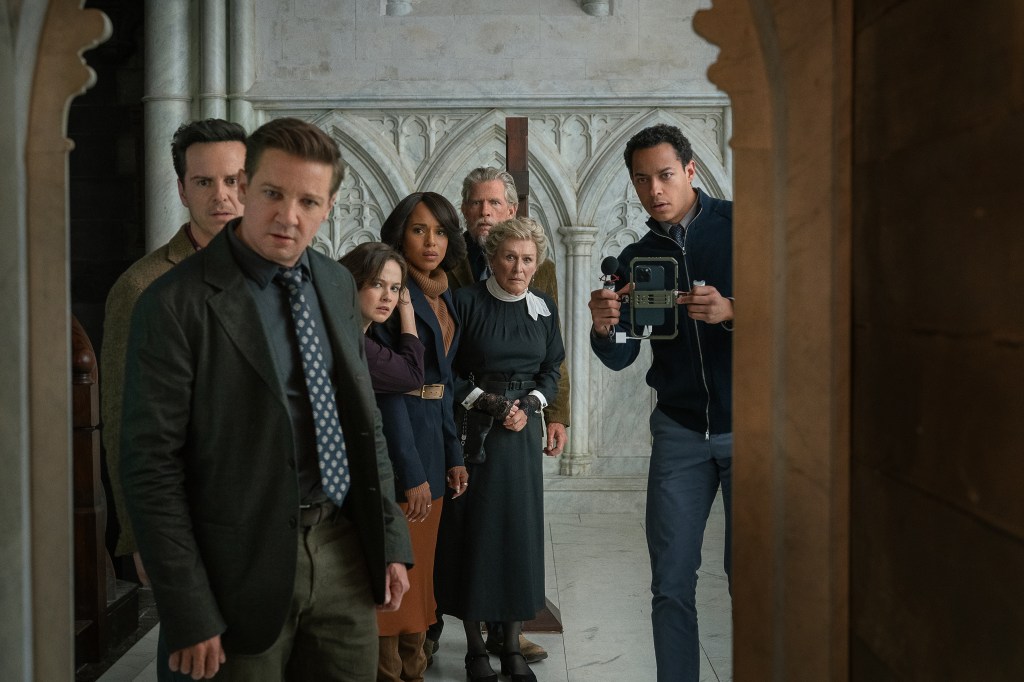
With the church taking centre stage, you should expect Johnson to have lots of fun with the lighting and music. The production is impeccable, both in creating the ambiance of the story and in evoking strong emotions. Nathan Johnonson’s score is the most essential element outside of the script and performances, with Steve Yedlin and Johnson’s cinematography and camera-work tying everything together beautifully. Wake Up Dead Man leads with its heart and emotionally resonant story, and for it to strike all the right emotional chords, the visual and sound design must effectively capture the darkness and light of the church. That and the heavy dose of comedy make Wake Up Dead Man a worthwhile experience.
The film is comical and poignant; it does revisit certain archetypes that Johsnon has not only established in the Knives Out series but also in his mystery TV series Poker Face on Peacock. It’s clear that he has a disdain for the current political climate and the bad-faith actors who exploit goodness with their greed. His protagonists are not entirely virtuous people; instead, they symbolize basic humanity. Marta Cabrera (Ana de Armas) is the kind nurse who, despite her disadvantages in life, always strived to give the best care she could to a man whose wealth and privilege were much greater than hers, and in the end, she was rewarded for her heart. Knives Out then built its surrounding characters to contrast and reflect the ills of our world, from financial greed, hunger for fame and cruel political ideals that stand against humanity and unity.
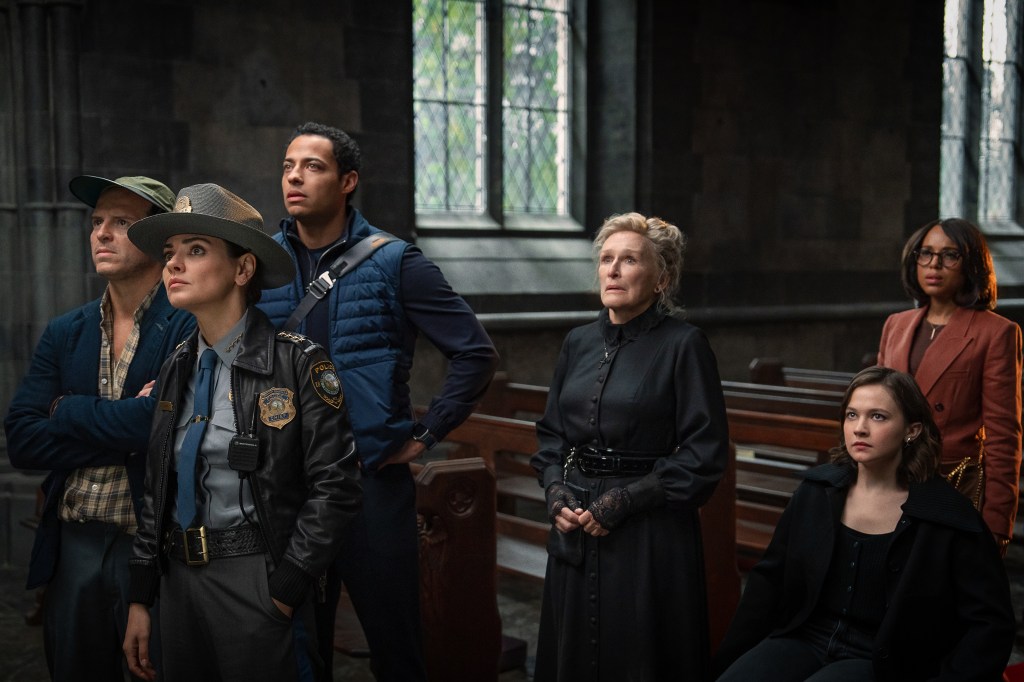
While Glass Onion focused on greed, Wake Up Dead Man zeroes in on faith and the ways it is weaponized for greed and politics. The jokes hinge on one’s understanding of the current landscape of the US, as well as the Catholic Church. Outside of these pointed jokes, the film has its moments of slapstick comedy that jolts the story to life every once in a while when the heaviness of the core subject threatens to plunge the film into pure drama territory. The comedy is true to Johnson’s style of writing and also to the Knives Out universe; it’s just very befitting. It hasn’t evolved by any means, but the consistency gives the audience that sense of familiarity that sustains a long-running film series.
Johnson is falling on his sword here. I greatly enjoy the mystery genre, and his kooky take on the archetypes that are often really on the nose about a point he is making or simply a fun subversion. Wake Up Dead Man is an example of how unsustainable franchise building is. Sometimes it’s okay to be a one-and-done movie. Novels have the grace of time and space to immerse oneself in the story. A series of books is more than capable of maintaining archetypes and convoluted plots because an author has the time to explore every angle, every character and expose their readership to the many possibilities. A movie doesn’t have that luxury; it has to be concise and maintain a balance between easy comprehension and complex plotting.
Wake Up Dead Man will either be looked at fondly for its change of pace or will be dismissed for not replicating the novelty of the first film, which isn’t actually fair to it at all. We should accept that Knives Out left an impression because it was the first film, and it set the formula for not just the rest of the series but for all the mysteries it has spawned from different film studios and television series. Wake Up Dead Man could have stuck closer to the formula, but thankfully, it didn’t; it tries to do something different. In my humble opinion, it far exceeded my expectations, because the expectations I had were to have fun and enjoy what was laid before me, a narrative that stands on its own.




 Muses of Media
Leave a comment