
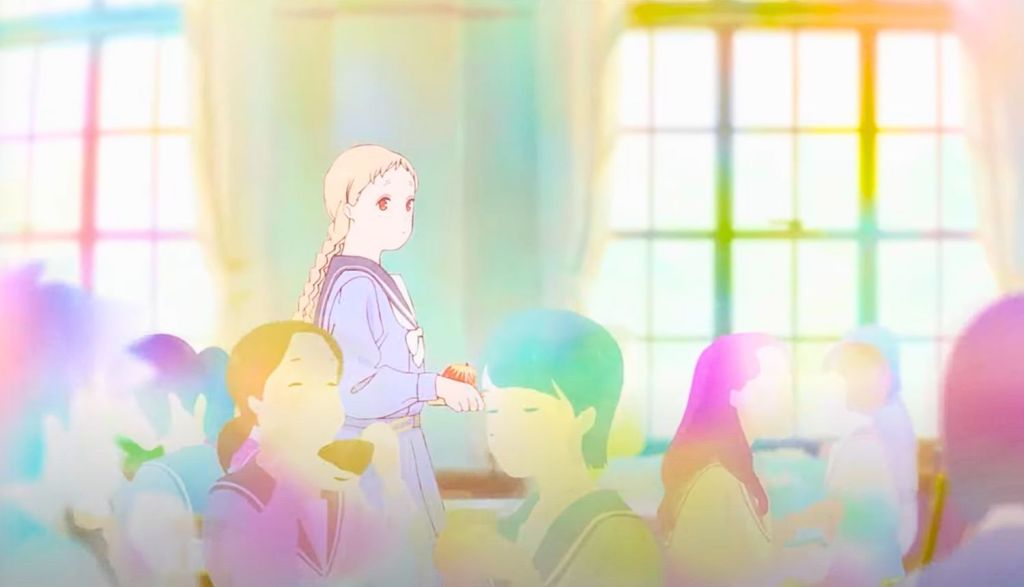
Naoko Yamada and Reiko Yoshida reunite for a sweet and tender portrait about friendship and self-expression. The Colors Within follows a special young girl who has synaesthesia, the ability to see people as colours. She lives a quiet existence, a shy and bumbling one, but she is a bit lonely. That is, until she sees her classmate who radiates a beautiful blue. What follows is them finding their rhythm as friends and learning to be true to themselves.

High school student Totsuko is a sweet young girl who seems to be wayward and lonely. She is easily distracted by the fact that she sees people as colours, an experience that others do not understand. Totsuko is then instantly drawn to a new classmate, Kimi, who becomes a source of fascination for Totsuko. It is easy to read Totsuko as queer, and her awkwardness and inability to speak on her feelings is due to her faith (she attends a Catholic boarding school) or her environment isn’t’ particularly open to her. The synesthesia is a nice metaphor for her experiences, but director Naoko Yamada has been clear that it wasn’t the intention. However, what is clear is that the film acknowledges the existence of an unspoken bond and attraction between those who are simply meant to be in each other’s lives. It is neither sexual nor platonic; it is merely a bond that unites.
The film is a quiet meditation about friendship and the power of music and art. There is minimal dialogue throughout, which forces Yamada to rely on visual language. To say that the film is beautiful is an understatement; from beginning to end, the film is breathtakingly stunning. The visuals are vibrant, as are the characters. Totsuko’s synesthesia is presented in a very romanticized manner, which endears us to her and her genuine excitement when she gets to befriend Kimi and Rui. It is not at all surprising that a film by Yamada is visually enriched by the emotional depth of the story told, particularly one written by Reiko Yoshida.
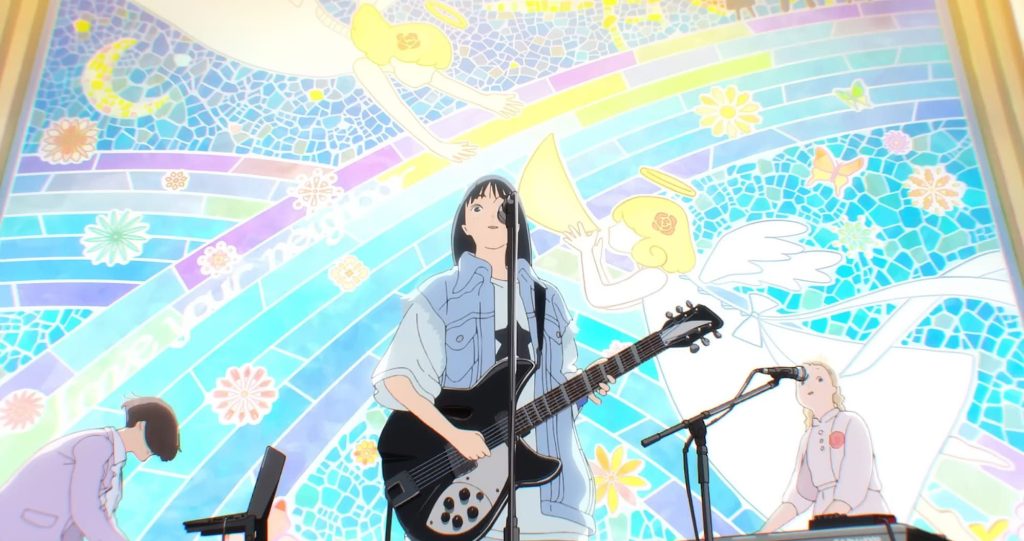
The Colors Within also boasts an excellent score and lively music that is true to the characters. The use of the theremin is a fantastic touch, as the electronic instrument is usually associated with the word ‘otherworldly,’ and that best expresses the connection these kids form. Their fates are intertwined thanks to a quirk. The film feels far more special as it explores the creative process, and the minimal dialogue accentuates the intuitive nature of music. Sometimes you don’t need to talk your way through creating art; it comes out naturally, as one experiences life.
Naoko Yamada and Reiko Yoshida’s collaborations always yield outstanding results, and The Colors Within is no exception. It is vibrant and emotionally satisfying. The characters are wonderfully drawn, the music is enjoyable, and the visuals are immensely moving and beautiful. Fans of A Silent Voice and Liz and the Blue Bird will find The Colors Within to be a sweet entry into a creative trilogy that explores the pathos of adolescence.





 Muses of Media
Leave a comment