
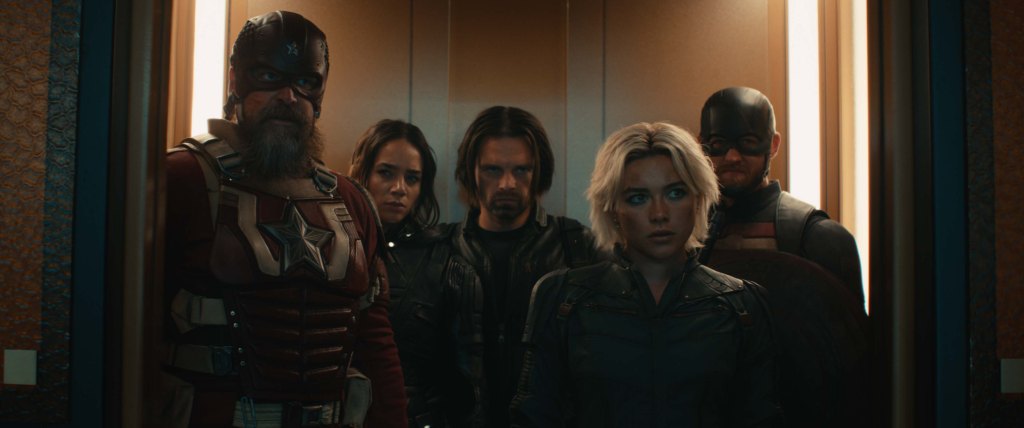
“The Avengers are not coming.” -Valentina Allegra De Fontaine
If you read books or watch movies, you’ll know there is no shortage of storylines that follow the outcasts or misfits who must team up and do something remarkable. At its baseline, this is what Thunderbolts* is. However, luckily for those who watch, it is also much more.
In Thunderbolts*, we find Yelena Belova (Florence Pugh) stuck in a rut. Since her sister’s death, she’s kept a low profile, taking jobs here and there, always alone. Yelena explains this decision in the film’s opening. Whether you’re a superhero, someone in the gray area between hero and villain, or a regular civilian, it’s easy to relate to Yelena’s thought process. When you do bad things, it’s only a matter of time before someone comes for you, and if they don’t, the likelihood that you will be alone with all the memories of the terrible things you’ve done haunting you is a sure thing.
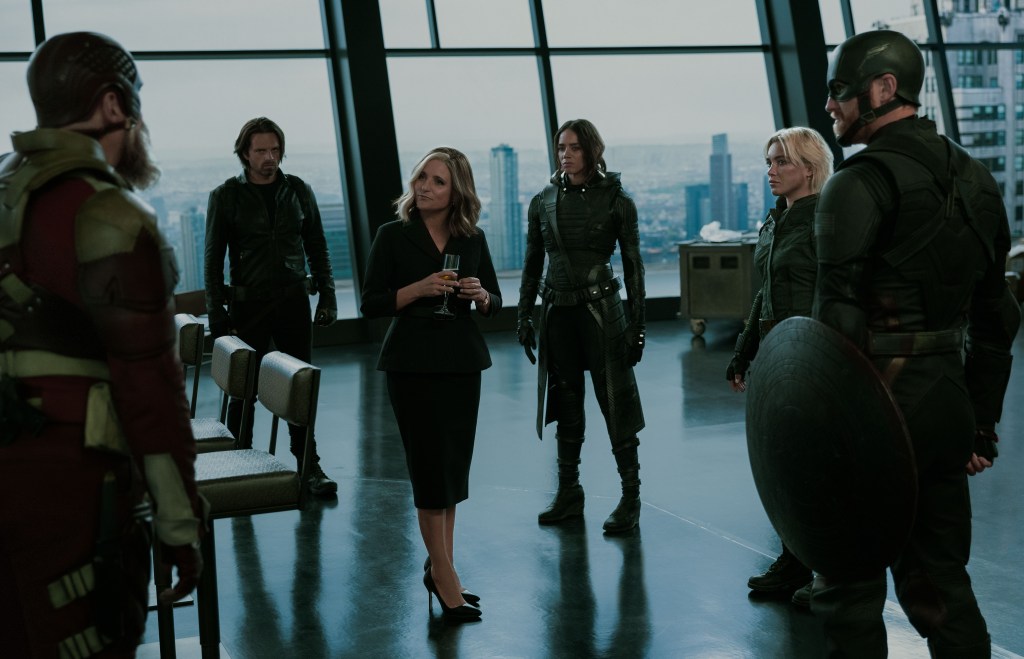
However, that process is often sped up when dealing with someone like Valentina Allegra de Fontaine (Julia Louis-Dreyfus). The former CIA director has been a thorn in the sides of superheroes and villains during her time in the Marvel Cinematic Universe (MCU). It’s been very clear that Valentina’s motives are far from good, as shown in Thunderbolts*. Valentina’s efforts to weasel her way into various spaces are quite nefarious, and things come to a concerning head in this film, causing an unlikely group of castoffs to band together for the greater good.
Directed by Jake Schreier, with a screenplay by Eric Pearson and Joanna Calo, Thunderbolts is a grounded and character-driven narrative that harkens back to earlier phases of the MCU, as well as a select few more recent MCU films, such as Shang-Chi and Wakanda Forever. It’s much less concerned with blowing things up, though there are some great action sequences, and more about telling a story that sheds light and shadow on the characters within it. The narrative is carefully crafted to give each character a moment to shine, allowing the audience to become deeply invested in their journeys. However, please make no mistake, Thunderbolts* is very much the Yelena Belova show, as it should be.
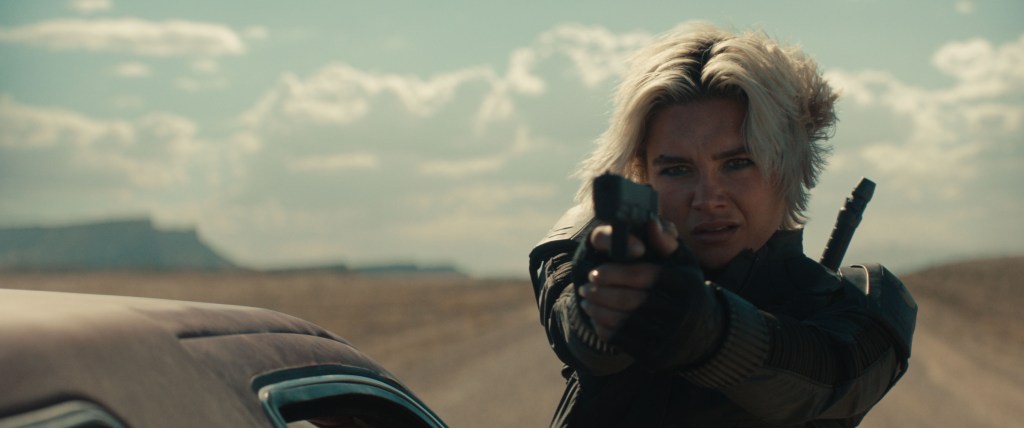
Florence Pugh’s Yelena is one of the best characters currently active in the MCU, and as per usual, Pugh brings her A-game to this performance. Pugh was a standout in Black Widow, often stealing the show, and she does the same in Thunderbolts*. Pugh is the kind of actor who will have audiences on the edge of their seat. Whether leaping from one of the world’s tallest buildings or having a heart-to-heart in a scene with a castmate, every moment Pugh commands the screen in Thunderbolts* is exceptional. Pugh is absolutely fantastic here, and it’s nice to see Yelena get more time to shine.
Pugh isn’t the only scene stealer, though. Julia Louis-Dreyfus as Valentina and Lewis Pullman as Robert “Bob” Reynolds/Sentry join Pugh in this regard. There haven’t been many women villains in the MCU, and the ones that audiences have encountered were often wasted (Hela being the main one that comes to mind). In Thunderbolts*, we finally get an interesting and threatening woman villain with Louis-Dreyfus’ Valentina. One could describe Valentina as condescending, high-strung, manipulative, and quietly volatile, and Louis-Dreyfus plays the part perfectly. You’ll love to hate her, and that’s precisely the point. Pullman does a great job of balancing Bob and Sentry, two sides of the same coin, but polar opposites. Pullman’s performance serves as an emotional throughline in the film, connecting the different characters for the better.
The rest of the cast is equally excellent. Hannah John-Kamen is back as Ghost, which was a treat, especially when you see much more of her this time. In comparison to her first MCU appearance in Ant-Man and the Wasp, audiences get a glimpse of Ghost’s personality and she’s quite funny, particularly when she’s poking fun at others in the group, particularly the pointed barbs she sends John Walker’s way – which he definitely deserves. When she’s not pulling a disappearing act, John-Kamen’s facial expressions are great (please note Ghost’s reactions to some of the Red Guardian’s commentary or Walker being an ass – comedic gold).
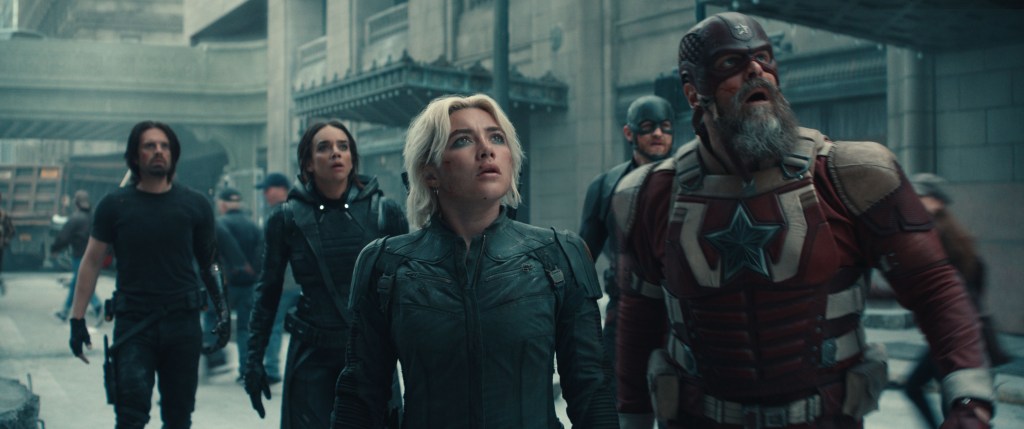
David Harbour is just as likable as Red Guardian in Thunderbolts* as in Black Widow. Funny and outlandish, it’s easy to see how much fun Harbour has when portraying this character. Wyatt Russell’s John Walker (a.k.a. Bargain Bin Captain America) is still as annoying and entitled as ever, and Russell plays the part well. It’s always great to see Sebastian Stan’s Bucky back in action and he has some great action moments in Thunderbolts*, as one would expect from the Winter Soldier.
Aside from the performances, the narrative propels Thunderbolts* to another level. It delves into the emotional struggles of the characters, exploring themes of loneliness, being an outcast, never feeling good enough, and the impact this has on people’s mental health over time. It hones in on the drastic measures people might take to escape that abyss, even if it might cost them a part of themselves they didn’t intend on losing. Most people have likely felt one, if not all, of these feelings at some point. We have felt the weight of the mistakes we’ve made weighing down on us, and the darkness that comes with it. We’ve experienced that void of emotions and peace calling us toward that darkness, all too invitingly. It is in this storytelling that Thunderbolts* sets itself apart from other MCU entries.
While there are some thrilling action set pieces, Thunderbolts* doesn’t rely solely on the action or nostalgia to intrigue audiences. It excels at telling a tale that, despite the mistakes and bad things one might have done in their past, there is a path to redemption and finding peace. We don’t have to feel alone when the darkness surrounds us. You are more than the sum of your broken parts, which is of the utmost importance to remember. Packed with phenomenal performances, intense action, and an emotionally impactful story, Thunderbolts* is one of the MCU’s best.





 Muses of Media
Leave a comment