

“We gotta de-queer the house!” –Chris
In an age where almost everything is fair game for the remake machine, it’s easy to feel jaded and damn near dismissive of any project that is a rehash of past narratives. However, when Andrew Ahn got involved in a remake of Ang Lee’s The Wedding Banquet, my worries disappeared, leaving me excited. Ahn has proven to be more than capable of taking known stories and fusing them with authenticity, humility, humour, and a generous dose of personality. While Fire Island is not an outright remake of Pride & Prejudice but rather an adaptation of the 200-year-old story, it exemplifies Ahn’s abilities to tell contemporary stories within a pre-existing framework that feels as unique and authentic as the original material.
This remake has shades of the original 1993 feature but has been revised to suit Ahn’s sensibilities and adapt to contemporary attitudes to queer stories and lives. In the 2025 film, we have two queer couples, a lesbian couple, Angela (Kelly Marie Tran) and Lee (Lily Gladstone) and a gay couple, Min (Han Gi-chan) and Chris (Bowen Yang). Angela and Lee are in solid places in their lives; however, they are weighed down by Angela’s unresolved feelings about her overzealous mother, May (Joan Chen), and the hardships of IVF treatments. Chris and Min are getting by, but Chris suffers from anxiety and indecision, and Min is at risk of losing his inheritance if he doesn’t return to Korea as per the demands of his grandparents.

The dilemma is that Angela and Lee want a baby, but after a failed IVF session, the couple has run out of money to spare. Min and Chris live in Lee’s guesthouse, and although both are in love, Chris is reluctant to progress in the relationship. Min is eager to get married, but is also running away from the pressure from his family in Korea. Min has money, but for as long as he conforms to his grandparents’ wishes, after a few too many drinks and heightened emotions, Min and Lee put their heads together and decide that Min should get married to Angela, a sham wedding that solves their issues. Angela and Lee get funding for their subsequent IVF treatment. Chris is given more time to decide what he will do with his life, and Min has a solid excuse to pursue his career and live independently in the US. The problem with their dilemma comes from Min’s grandmother, Ja-Young, who surprises the conspiring couples with a visit and demands a real Korean wedding.
The quartet’s issues collide, forcing them to reassess their respective relationships, familial bonds, and current status as a chosen family. What simmers beneath the surface is their shared desire for a strong family unit that doesn’t necessarily conform to society’s expectations but satisfies their needs and wants.
The Wedding Banquet emphasizes its themes by exploring Angela’s strained relationship with her mother and Min’s relationship with his grandmother as the soon-to-be newlyweds grapple with the old guard’s expectations for their futures. Ja-young, Min’s grandmother, is a prim and proper woman who adheres to her husband’s ways to save face and maintain an image of the perfect Korean dynasty, with Min taking on the mantle. May is overly eager to embrace her daughter’s sexuality and devotes her entire identity to being an advocate. Still, May is missing the key to being a parent: listening to their child. These two relationships work in tandem to create a broader portrait of what a chosen family provides to someone in the queer community, but most importantly, these relationships illustrate the power of expressing your feelings openly and honestly. Ja-Young and May are two sides of the same coin, both deeply entrenched in tradition and rigid family ideals, but they have two entirely different reactions to Min and Angela’s sexuality. Both are seemingly well-intentioned but cause harm nonetheless.

The narrative is a balancing act throughout, toeing the line between drama and comedy, offering audiences hearty laughs and tear-jerking moments. The characters are heightened versions of ordinary people, with Min serving up a dash of Korea’s brand of drama as the grandson of a chaebol running away from his family business. A key ingredient in grounding the narrative is the cast, like Tran and Yang specifically, who offer very sincere portraits of people struggling with self-sabotaging behaviour. The visual language is also incredibly vital, as cinematographer Ki Jin Kim brings a sense of calm, steadiness and naturalism. Charlotte Royer and Josh Plaw’s production and set design also create a sense of belonging in every space these characters inhabit.
Ahn and James Schamus’ script is well-balanced for a romantic dramedy. A great deal of romantic, platonic, and familial love shines throughout the film, with each relationship oscillating between dramatic and comedic moments. Firstly, it is utterly comical for these four to think they can get away with a green card wedding without getting caught. Our four leads are a comical foursome, navigating the most challenging transition from adult to adult and being responsible for more than themselves. Here is where the drama stems from: Angela, Lee, Chris, and Min are humans who are bound to make mistakes, have mishaps in expressing their emotions, and are still learning to heal from their respective pasts. The writing is a delicate dance between jokes and seriousness, and what helps create the appropriate environment for this story is the acting.

This cast is spectacular. The warmth and care these actors infuse into their characters is palpable, but their electric chemistry raises the film’s profile. Bowen Yang reunites with Ahn after a delightful performance in Fire Island. Chris’s indecisiveness and fear of making big life choices are so relatable, perhaps the most relatable character arc in the film. Yang is a comedic genius but also excels at giving grounded, sincere dramatic performances. Lily Gladstone’s Lee is the steadfast rock of the group, the one with the most apparent motivations, the most transparent character work, and the one with the most to lose if the ruse falls through. Gladstone is charming, graceful, and effortlessly charismatic. Playful when needed and serious when the situation demands it.
Kelly Marie Tran’s Angela is so troubled that you can see it in her posture. Despite being in a relatively happy relationship with Lee, you can see how much her issues with her mother weigh her down. With oversized clothing and Tran’s extremely expressive performance, it’s as though Angela is shrinking under pressure, especially in her mother’s presence. Tran’s character certainly isn’t the most pleasant of people, but she is representative of so many people, queer or not, who internalize everything, which impairs their perception of their reality. Tran’s portrayal is sensitive and delicate, edging toward unbearable but pulling us in gently.
However, the film’s runaway star is Han Gi-Chan, as Min is diabolical. It is hard to gauge how seriously he took everything, but his blasé attitude and childlike mannerisms were a source of great comfort and laughter. However, Han is adept at bringing the more sensitive qualities of the script to life, as he is an integral part of the script’s emotional maturity. Han has fun embellishing Min’s less serious quirks but then holds his own while sitting across from a legend like Youn Yuh-jung. He captures the tender balance between youthful abandon and a young man becoming the master of his destiny very well.
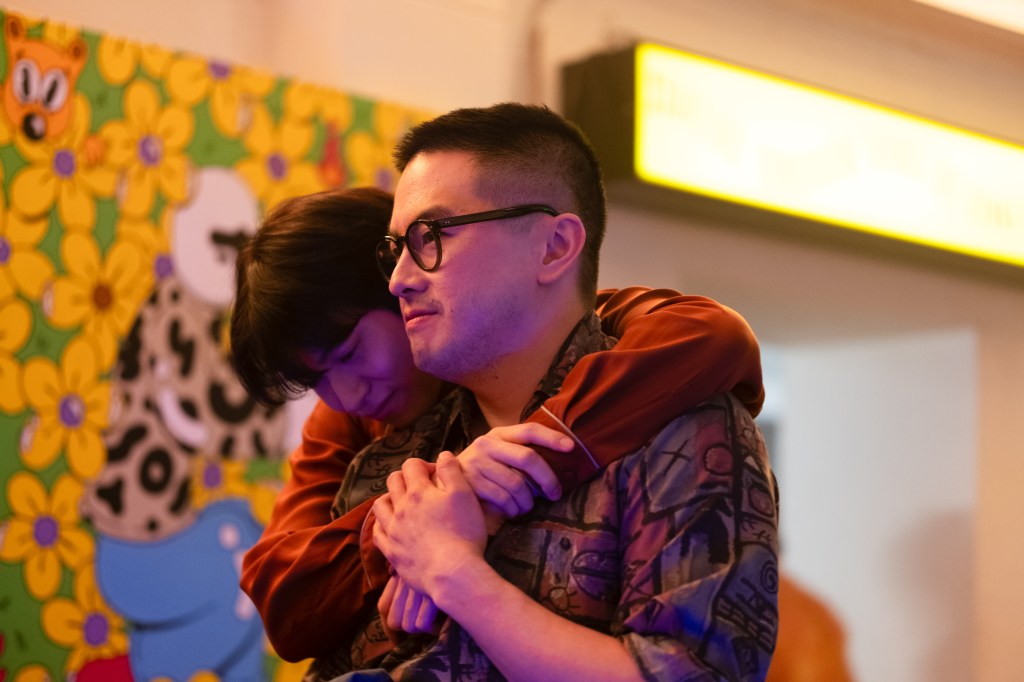
The film, at face value, is a fun dramedy about a group of friends getting up to some hijinks to enrich their lives. It also tells a deeply profound story about family and how we treat one another within these dynamics. Joan Chen and Youn Yu-jung play two characters that could have easily been failed in the hands of another writer, made to be the butt of the jokes and exploited as overplayed stereotypical depictions of Asian maternal figures. However, Ahn subverts expectations while exploring the complicated nature of acceptance and tolerance when other emotions influence them. As much as the film is about the core four reassessing their relationships and navigating adulthood, The Wedding Banquet deepens that narrative by exploring these central relationships that have an impact. Ultimately the goal is to establish the palpable difference between chosen family and blood family within queer spaces.
The Wedding Banquet is a perfect example of a remake that doesn’t fall prey to nostalgia. Andrew Ahn and James Schamus wrote a story inspired by Ang Lee’s The Wedding Banquet of 1993. Still, they opted to tell a story that is personal and resonates with audiences today, particularly the queer community, who have very different experiences from those living in the ’90s. Most remakes expect to indulge in what we love about the original. However, the wedding banquet not only clears that bar, but it doesn’t just rest there. It goes above and beyond to feel like an original in its own right. Every aspect of the film is like synergy, from the writing to the casting to the cinematography. The Wedding Banquet has all the qualities of an instant classic: funny, honest, authentic, and emotionally satisfying.

 Muses of Media
Leave a comment