

This review was published during the WGA and SAG-AFTRA strikes of 2023. The Boy and the Heron would not exist without the labour of its writers, director, actors, and the many departments integral to the filmmaking process. Learn more about the demands of actors and writers here.
When Studio Ghibli chose not to release any promotional material for Hayao Miyazaki’s latest, and possibly last, animated film, How Do You Live? (retitled to The Boy and the Heron for North American distribution), the world heard the revered animation studio loud and clear–you don’t want to miss this one!
To honour the intention of Studio Ghibli, this review will be as vague as possible when it comes to the plot. However, if you are familiar with Genzaburō Yoshino’s 1937 novel Kimitachi wa Dō Ikiru ka (How Do You Live?), then you have more than enough to prepare yourself for this fantastical tale. For the uninitiated, the story follows a young boy, Mahito Maki (Soma Santoki), as he is lured by a mysterious grey heron (Masaki Suda) to an abandoned tower on his family’s property.

The film is perhaps Miyazaki’s most personal film. Much like Guillermo del Toro and other auteurs of genre film, no matter how fantastical their movies may be, their lives inform the direction they take their stories. Set against the backdrop of 1943 Japan, during the Pacific War, Miyazaki imbues much of Mahito’s life with his childhood memories. At the core, Miyazaki has crafted his most intimate story, with Mahito’s tale emphasizing the themes of growth, grief, forgiveness and coming-of-age. Miyazaki also delves into the belief that children are the future of a world without violence, a piece further illuminated by the war and his father’s line of work as the backdrop. The novel on which this film is based covers many of these themes, but Miyazaki has applied his own interpretation.
As the film’s writing evokes this deep connection to Miyazaki’s life, the visuals bring together nearly 40 years of excellence from Miyazaki and Studio Ghibli. There is a reason that in addition to traditional theatres, The Boy and the Heron is being pushed into premium formats such as IMAX. This movie is a spectacle! Atsushi Okui’s cinematography paired with Miyazaki’s colourful, dynamic 2D animation take the audience on a whimsical, vibrant, awe-striking adventure that is a feast for both the eyes and soul. While Disney remains stagnant with 3D animation that is often devoid of life and is merely a show of technical prowess, Miyazaki and the creatives at Studio Ghibli see the value in traditional animation and hard earned emotional payoffs. The world around Mahito is beautifully realized, capturing the story’s realism and fantasy. Each frame is a delicate painting, fully grasping the depths of emotion embedded into the story of a young boy on an epic adventure.
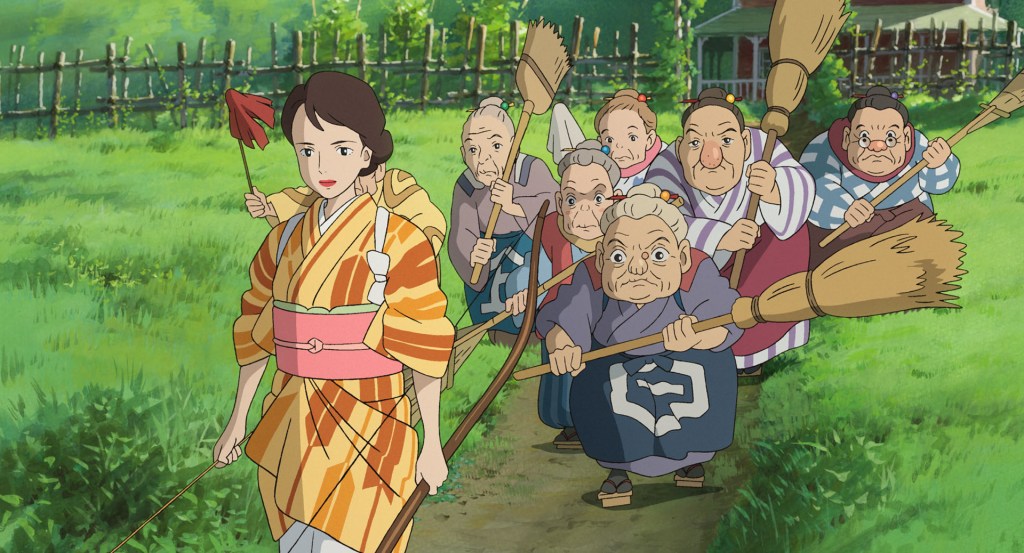
The creative choices are evocative and inspired, with little indication that any action taken during this production was made just to be flashy. Every choice is heavy with intent. After faking us out for the millionth time with his retirement, Miyazaki returned to tell a story that is a culmination of his life’s work. Together, the tale and the animation paint a picture of a man who has poured his whole life force and heart into his craft and is gifting the world and his loved ones with this cinematic opus. It is in the details that you feel the vibrancy and vitality Miyazaki still possesses after all these years. The story’s complexity and the remarkably emotional final bow do not distract from the reality that it is perhaps the most colourful, artful, and timeless film to be born from Miyazaki’s memories and imagination.
As the credits roll on the wondrous journey, one filled with peril, despair, pain, and sorrow, the audience will feel Miyazaki’s profound hopefulness, passion, and love for life and art. How Do You Live? is what the film should be called. Yes, there is a boy and a heron, but such a pointed, obvious, descriptive title does not reflect the heartwarming wistfulness of Mahito and Miyazaki’s story. How Do You Live? is an apt title because it gets to the heart of this film’s central question–it is also directly referenced in the film itself. Miyzaki’s work is a obvious as it can be, if you are someone open to enjoying a thought-provoking emotional tale, but what Miyazaki excels at is, subtlety, and this new title for Western audiences betrays that. However, regardless of the title, the film begs to be seen as soon as possible.
Miyazaki decided not to attend the Toronto International Film Festival (TIFF) to promote the world premiere of his movie, as he intended to “raise the film’s mystique” and he is right to shroud the film in mystery because the film is best when one experiences it with fresh eyes, a clear mind, and an open heart.





 Muses of Media
Leave a comment